Compensation Lake Design and Monitoring for Fisheries Act Offsetting
Client:
Various Oil Sands Operations
Location:
Athabasca Oil Sands Region (Northern Alberta, Canada)
Dates:
2010 – Ongoing
Background:
Development in the Athabasca oil sands region has required numerous fish habitat offsetting projects, which are mandated under Authorizations pursuant to the Fisheries Act. Hatfield has supported our clients in the design, permitting, construction, and long-term effectiveness monitoring of the most complicated of these undertakings: large-scale lacustrine habitat creations. Our expertise, local presence, excellent reputation, and established relationships with provincial and federal government agencies ensure that these projects successfully address regulatory requirements and meet environmental performance objectives.
Services Provided:
Habitat Design and Permitting
Hatfield has supported compensation lake design for several oil sands operators. Our contribution to the refinement and validation of habitat suitability models for northern boreal fish species enables us to provide region-specific context and expertise to our clients. We are adept at working within multi-disciplinary teams, where we provide environmental design inputs to optimize habitat offsetting credits and cost-effectively satisfy regulatory approvals. Design considerations include the physical, biological, and chemical features required for constructed aquatic habitats to develop into self-sustaining ecosystems. Our team of experts provide a range of services related to habitat design and permitting, including:
- Incorporation of habitat suitability criteria for target fish species into lake design specifications, including inlet and outlet watercourses, to maximize habitat gains.
- Detailed hydrological, climate, and water quality modeling to predict habitat function and inform the selection of appropriate design criteria.
- Integration of nature-based solutions to address climate change resilience, erosion control, riparian revegetation, and upland landscape components, to strengthen overall ecosystem function.
- Baseline characterization and environmental effects assessments to support regulatory applications for compensation lake projects (Fisheries Act Authorizations, EPEA Approvals, Water Act Approvals, Wildlife Act Permits, and Species at Risk Act Permits).
- Project-specific mitigations, monitoring plans, and environmental management plans for construction and operation phases of development.
Effectiveness Monitoring
Most compensation lake projects have a commitment to monitor effectiveness for 10+ years to demonstrate conditions of regulatory approvals have been achieved, and compensation measures are tracking towards self-sustaining ecosystems. Hatfield has developed protocols to assess the effectiveness of large-scale lacustrine habitat creations in collaboration with Fisheries and Oceans Canada and industry partners. We have designed and implemented effectiveness monitoring programs for numerous major compensation lake projects, several of which have received regulatory certification and sign-off. Our expertise, understanding of local fisheries management objectives, and ability to apply adaptive management strategies informed by year-over-year monitoring provide our clients with a cost-effective approach to manage the regulatory risk of these large-scale habitat compensation investments.
Effectiveness monitoring conducted by Hatfield is designed to achieve two primary objectives:
- Characterize the physical, chemical, and biological characteristics of the offset habitat to ensure it satisfies the conditions of the regulatory approvals and it is progressing towards a naturally functioning ecological system.
- Quantify habitat gains and fish productivity to confirm that the offsetting counterbalances authorized project impacts.
Our technical staff monitor a wide range of biotic and abiotic factors with the type and frequency of monitoring dependent on the approved effectiveness monitoring plan and regulatory conditions, including:
- Comprehensive limnological water quality assessments
- Sublethal (chronic) toxicity testing of water and sediment
- Continuous in situ water quality monitoring
- Inlet and outlet gauging and lake level monitoring
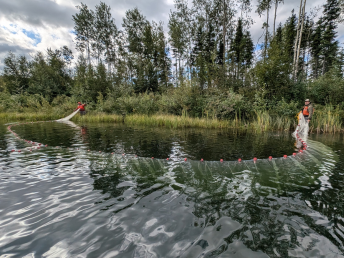
- Macrophyte, plankton, benthic invertebrate, and fish community assessments
- Mercury bioaccumulation monitoring
- Stratified fish abundance and biomass sampling
- Fish passage assessments
- Real-time meteorological monitoring